The United States Holocaust Memorial Museum, opened in 1993, is part of a new global trend in how we remember the past. From Rwanda to Cambodia, memorial museums are rooted in a “never again” post-Holocaust conviction that memories of the past crimes should be harnessed to safeguard and promote human rights in the present and future. Rather than attempting to uplift and inspire, memorial museums spotlight humanity at its worst based on the belief that we can and should learn from the past. Until recently, however, the United States lacked memorial museums that featured its own violent past. As evidenced by the continued existence of hundreds of monuments to the Confederacy, American exceptionalism resides in a refusal to confront shameful chapters in its past.
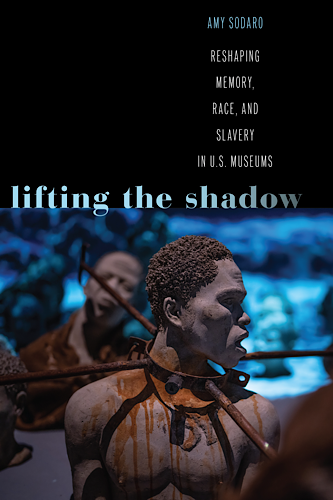
In her book, Lifting the Shadow: Reshaping Memory, Race and Slavery in U.S. Museums, Amy Sodaro looks at three new museums and how they address the history of slavery and racial violence. The National Museum of African American History and Culture in Washington D.C., the Legacy Museum in Montgomery, Alabama and Greenwood Rising in Tulsa, Oklahoma all represent a significant departure from American museum practices. They break with a longer history of African American museums that emphasize an uplifting story of struggle and achievement. They target a broader American public, not primarily African Americans, and they aim to integrate their accounts into the broader narrative of American history. Rather than leaving the past in the past, visitors learn about continuities in the present and are encouraged to take action to safeguard and further the advancement of fundamental human rights.
The signature achievement of the National Museum of African American History Culture (NMAAHC) is its success in resisting efforts to tuck it away in an inconspicuous corner of the capital. Situated in a prime location on the Washington Mall, the NMAACH showcases the history of slavery and the struggle for civil rights on the nation’s front lawn. Inspired by the Antiques Roadshow series, founding director Lonnie Bunch appealed to and benefited from an outpouring of support from the African African community to amass a rich collection of objects and artifacts. The NMAACH is truly a house built by and one that resonates deeply with the African American community.
Yet Amy Sodaro notes that the NMAACH was always destined to be a success and a failure. This was because it had to reconcile two irreconcilable missions. It had to tell the story of African American suffering and victimization and the story of resistance and resilience. Throughout the museum, the curators go to great lengths to strike a balance between past crimes and injustices and concomitant triumphs and accomplishments. Divided into floors that ascend through time, visitors move from the history of the slave trade and slavery through the civil rights movement and ultimately to the election of Obama and the promise of a post-racial America. Sadly, just a few short weeks after the museum opened, the optimism of its narrative was undercut by the election of Donald Trump.
Whether purpose built memorial museums are able to inspire visitors to effect positive change is an unresolved question. This is the aim of the Greenwood Rising completed in 2021. Greenwood Rising is devoted to telling the story of the 1921 Tulsa Race Massacre, one of the worst atrocities in the nation’s history. In a span of a 24 hour period, fabricated charges of a black riot were used to deputize and arm mobs of white assailants who proceeded to murder local black residents and set fire to homes and business in the prosperous Tulsa community known as Black Wallstreet. When the smoke cleared some thirty-five blocks of Tusla lay in ruins. Blamed for the events and denied compensation, the memory of Tulsa Race Massacre was suppressed for decades by the white media and political establishment.
What has been missing from the memorial landscape in the United States are museums and memory sites focused on past atrocities that implicate the United States, such as the genocide of Indigenous peoples and slavery. However, in the last few years there appears to be space opening up in American historical memory to address and incorporate more contentious and difficult pasts, including—and especially—slavery and its legacies of racial violence. Amy Sodaro, Lifting the Shadow: Reshaping Memory, Race and Slavery in U.S. Museums.
In keeping with recent memorial museum trends, Greenwood Rising relies more on technology than objects to sensitize visitors to the past. To ensure the desired experience, Greenwood Rising uses guides to shepherd visitors through a series of digital displays and films. While the museum covers the broad sweep of the city’s past the centerpiece is the 1921 Massacre. To engage visitors in this past, the museum offers the immersive experience of a period barbershop where visitors can sit in the barbershop chairs and watch holographic images of the barbers discuss the “hopes, dreams, and activities of the folks of early Greenwood.” For the actual presentation of the massacre a cinematic depiction of the events is projected in a darkened room on staggered pillars that evoke the destruction of the city.
Are memorial museums more effective in creating an embodied experience of the past, a prosthetic memory that will motivate visitors to take action in the present? In the case of Greenwood Rising, Amy Sodaro seems highly skeptical. Despite the polished use of digital media technology in a sleek, modern museum, Sodaro argues that visitors to Greenwood Rising can far too easily assume the role of spectators rather than engaged participants. Moreover, to elicit a lasting and meaningful response from visitors, Sodaro asserts that memorial museums need to offer concrete outlets for civic engagement. In the case of Greenwood Rising, visitors finish their tour by leaving commitment cards that are projected on an illuminated board, which Sodaro describes as a form of “slacktivism” that requires no real future engagement or action. Sodaro adds that many local black fail to identify with Greenwood Rising. They regard the museum as part of a gentrification project rather than an effort to address the greater need for reparations.
If there is one memorial museum that, in Sodaro’s opinion, seems to get it right, it is the Legacy Museum. The project grew out of the legal advocacy work of Bryan Stevenson. Stevenson rose to national prominence through the creation of the Equal Justice Initiative (EJI). Since 1989 the EJI has been providing “legal representation to people who have been illegally convicted, unfairly sentenced, or abused in state jails and prisons.” The EJI has taken a strong stand against the death penalty and has succeeded in overturning over 140 wrongful capital punishment convictions. Stevenson’s bestselling memoir, Just Mercy (2015), became the subject of a movie featuring international superstar Michael B. Jordan. From interviews with Oprah Winfrey to Katie Couric, Bryan Stevenson has used these media platforms to repeatedly call on the nation to confront its violent past.
Convinced that legal advocacy has its limits in the current conservative context, Stevenson turned to history to make his appeal directly to the American people. Located in the symbolic heart of the civil rights movement in Montgomery, Alabama, the Legacy Museum harnessed the legal power of the EJI to make the case that mass incarceration in the United States is part a longer history of racial violence. Inspired by the example of memorial museums around the globe and their absence in the United States, Stevenson became convinced that an effective presentation of the past could be the best way to change hearts and minds in the present.
The Legacy Musuem is organized along a clear timeline with four provocatively titled periods—kidnapped (slavery), terrorized (lynching and convict leasing), segregated (Jim Crow segregation) and incarcerated (mass incarceration). Everything from photos of lynchings to Supreme Court rulings are deployed to present an incovertible body of evidence that rather than ending, slavery evolved into new forms of racial terror and oppression. Careful attention is given to using the color white to frame ideas and actions in support of racial oppression and red to underscore African American resistance and resilience. Words like “racial hierarchy” and “cast system” are deliberably and repeatedly used to spotlight the creation of enduring, structural forms of racism.
From the start of the visit the Legacy Museum effectively uses technology to directly appeal to visitors. At the outset vistors encounter reproductions of slave pen with holographic images of captives who beseech them with stories of the horrors of the slave trade. At the end visitors come full circle with the opportunity to pick up a telephone and engage with video recordings of real death row inmates in a simulated visitation room. These stories of captivity, and the opportunity for visitors to engage directly with them, anchor the past to the present.
The work of the EJI has been exceptional in so many respects that Sodaro has serious doubts about whether it can serve as a model for other memorial museums. Because of its extensive efforts to anchor the memory of lynching in the communities where the crimes occurred and its history legal advocacy work on behalf of the wrongfully convicted, the EJI enjoys unmatched credibility and authority. A private organization that has been exceptionally successful at fundraising, the EJI also benefits from an unusual degree of independence in charting its own course. From the hotel it recently opened to the creation of a new legacy memorial park and squares in and around Montgomery, Alabama, it carries considerable weight and influence in one of the nation’s reddest states. What the EJI has made abundantly clear in drawing over 500,000 visitors to the Legacy Museum alone in 2021, is that there is a very real interest and undeniable market for confronting even the darkest chapters in the nation’s past.

Amy Sodaro
Amy Sodaro is Professor of Sociology at the Borough of Manhattan Community College in the City University of New York. She is the author of Exhibiting Atrocity: Memorial Museums and the Politics of Past Violence and Lifting the Shadow: Reshaping Memory, Race and Slavery in U.S. Museums.