Spain’s Pacto del Olvido (Pact of Forgetting) was once regarded as the gold standard for how to achieve a bloodless transition from dictatorship to democracy. There were no prosecutions for the crimes committed during the civil war and the nearly four decades of Franco’s rule. This was the agreement reached after the death of dictator Francisco Franco in 1975. But memories of the past could never be repressed, especially in places like Barcelona, one of the most important Republican strongholds and a site of radical reforms during the civil war. British native Nick Lloyd, renowned creator of the Spanish Civil War tours, has been telling the story of the civil war past in Barcelona for over twenty years. It is a past, he explains, which continues to divide and distinguish Barcelona from other cities in Spain.
Nick Lloyd had been living in Spain for nearly fifteen years before he became interested in the civil war past. It was during the early 2000s, Nick explained, that the city government of Barcelona began to devote more commemorative resources to the civil war. In his neighborhood of Poble-sec, the local library was named after Francesc Boix. An inmate at the infamous Mauthausen concentration camp where thousands of Spanish republicans were worked to death, Boix used his job developing photographs to secretly preserve the largest photographic record of German concentration camp crimes to survive the war. Boix went on to become the only Spanish citizen to testify at the Nuremberg trials. His photos helped secure the convictions of several high level Nazi officers.
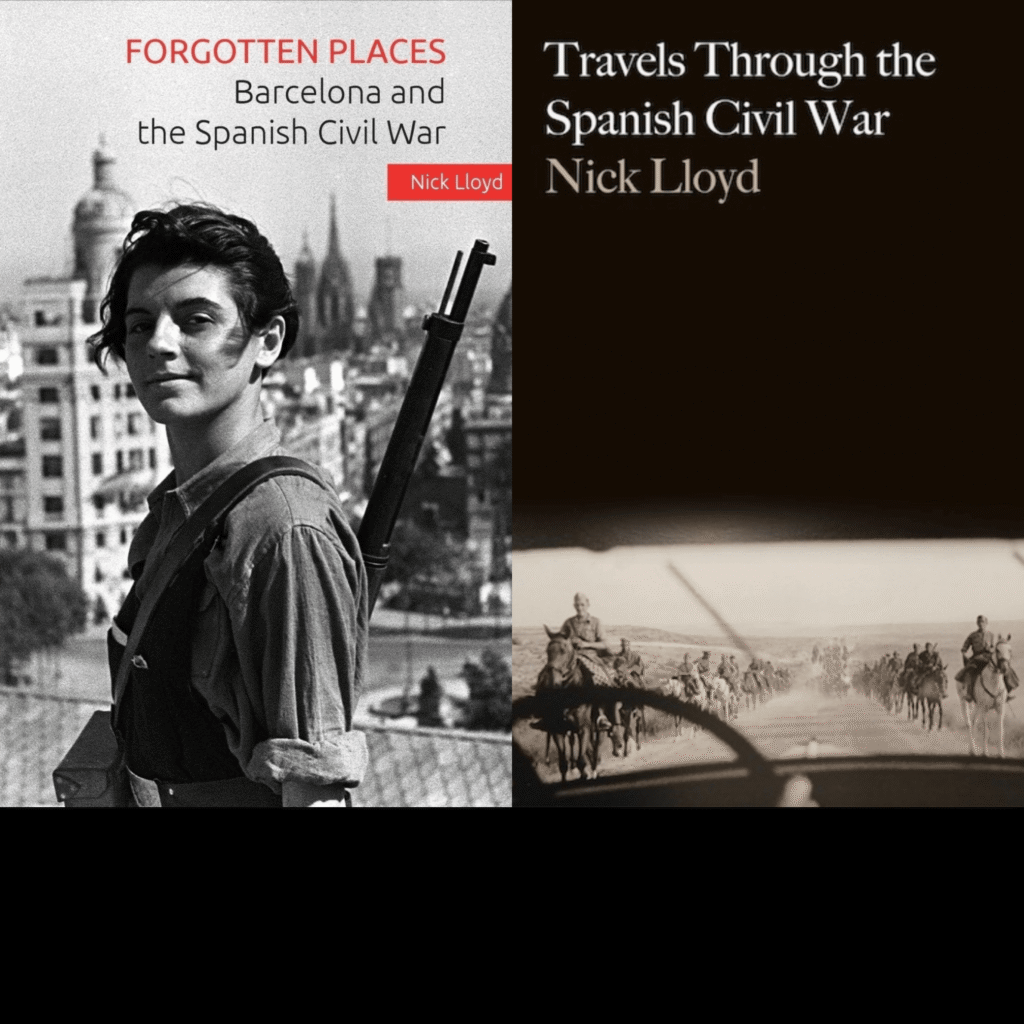
In contrast with England, Nick explained, local libraries in Catalonia are exceptionally well-funded community resources, often with specialized collections and related guest speakers. At a time before the proliferation of information on the internet, his library hosted talks and developed a collection on the Spanish Civil War and its connection to the Holocaust. Around the corner from his home, it was his local library that sparked his interest in the civil war past and his fascination with the life story of photographer, Francesc Boix. Together with Marina Ginestà, whose iconic photograph Nick used on the cover of his book, Forgotten Places: Barcelona and the Spanish Civil War, Boix is a central figure in the Civil War tours.
Nick’s Civil War tours have earned high praise from television travel personalities such as Rick Steves, and I too, was impressed by the depth of his knowledge and his enthusiasm for the past. He refers to himself as a walking museum because of the bag he carries and the suitcase on wheels he pulls filled with photographs and authentic artifacts that allow guests to see and touch the remains of the past. This is a complicated past, which is why Nick takes four hours to explain it. From the political backdrop that inspired police officers and workers to unite to foil the attempted military coup in Barcelona to famous writers like Hemingway or Orwell who wrote about and even participated in the conflict, Nick covers the expanse of political intrigue, revolutionary drama, and celebrity reporting that secured the lasting international memory of the Spanish Civil War.
The more and more that’s being done…This new Memory Law or moving Franco from the Valley of the Fallen, and all of those other things that have happened, the more and more the right has reacted…[But] how could you have a state where there’s 115,000 to 120,000 people in unmarked mass graves from just three generations ago? How can you have a state? How can you have a democratic conversation with that skeleton in the cupboard there? Conversation with Nick Lloyd, 24 August 2025.
Nick is not shy about challenging enduring myths of the Spanish Civil War. While it is true that women gained access to new employment opportunities on the home front, photographs of gun-toting women like Marina Ginestà were far from the reality of a Spanish culture that still retained deeply conservative attitudes about women. Although Nick holds the writing of George Orwell in high regards, he is careful to point out how the scope and scale of the conflict were far too complex for Orwell to grasp from his limited exposure. Despite the valiant efforts of the Republican side to stay the course, Nick stresses that this was a lopsided conflict from the start. Not only did Franco’s army possess the best battle-hardened soldiers fresh from the killing fields in Morocco, but they had also most of the weapons and most of the international support from Hitler’s Germany and Mussolini’s Italy. The major democratic powers of the day, Britain and France, refused to lend support, while American oil, ships, and finance helped bolster Franco’s forces.
Subjected to attacks by Mussolini’s pilots and a testing ground for Hitler’s Luftwaffe, Barcelona was bombed and starved of resources until it was finally overrun by Franco’s forces. While urban renewal has erased many of the scars of the past, Nick’s tour spotlighted the traces of shrapnel and bullet holes that are still visible at various sites around the city. This was a conflict that claimed significant numbers of lives on all sides. But while the Republican side kept a record and sought to punish those responsible for some 50,000 victims associated with leftist violence, we still have no exact record of the far greater number of Republicans murdered or worked to death by the Franco regime. To the present-day thousands of victims of Franco’s violence remain buried in mass graves scattered across the country.
Nick used to give a tour, once a month, of Fossar de la Pedrera. This is the site where hundreds of Republicans were summarily executed and buried by the Franco regime at the conclusion of the war. For some of those who take Nick’s tour this is an emotional site that recalls the lives of family members cut short by Nationalist retribution. Nick notes that for years, after the end of the Franco regime, the typical conservative refrain was that it was best not to talk about the war because all sides suffered. But Nick adds that the winning side did nothing but talk about the war for thirty-eight years.
Barcelona has a longer tradition of commemorating the civil war past and support for the republican side is more broad based than in other parts of Spain. Guides who give civil war tours to cities like Madrid need to contend with a political landscape where the dividing lines are much more clearly drawn. Today, Nick notes, parts of the conservative Popular Parti, and certainly the right wing Vox party, are much more outspoken in their support for the Francoist past. When the current government of Socialist Prime Minister Pedro Sánchez, decided to commemorate the 50th anniversary of Franco’s death in 2025 with events meant to celebrate Spain’s democracy, many conservative leaders refused to participate.
Spain continues to have what Nick describes as a schizophrenic relationship with its Civil War past. For example, the former Olympic Stadium in Barcelona, which is now the temporary home of the famed Barcelona soccer team, is named after Lluís Companys, the Republican president of Catalonia during the Civil War. After the victory of Franco’s forces, Companys fled to France with thousands of other Republicans. Handed over to the France regime, Companys was tried and summarily executed, the only democratically elected president to suffer this fate at the hands of a fascist state. Today Companys is one of the most recognized personalities in Catalonia with hundreds of streets, avenues and squares named after him. But it wasn’t until the enactment of the Democratic Memory Law in 2022 that Companys, like thousands of other Republicans, was finally acquitted of the charges of treason.
It is precisely the naming of streets and squares after personalities like Companys that fuels the memory wars in Spain today. Whereas once Spain seemed to be moving toward reconciliation, Nick now believes that the dividing lines are widening. Cities like Madrid, that had made efforts to address the Republican past, have since seen those projects dismantled and undone by successive conservative governments. Even the younger generations find themselves split over their views about the Franco regime. If time heals all wounds, it seems that more time needs to elapse to overcome the ongoing legacy of division from the civil war past.
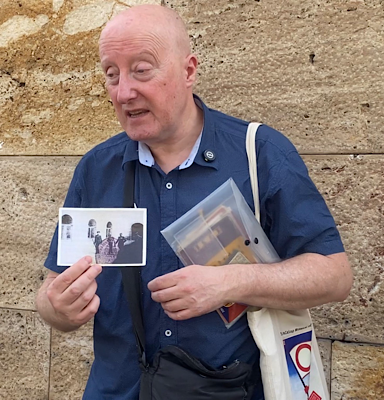
Nick Lloyd
Nick Lloyd is the creator of Spanish Civil War tours in Barcelona. He is the author of Forgotten Places: Barcelona and the Spanish Civil War and Travels Through The Spanish Civil War.