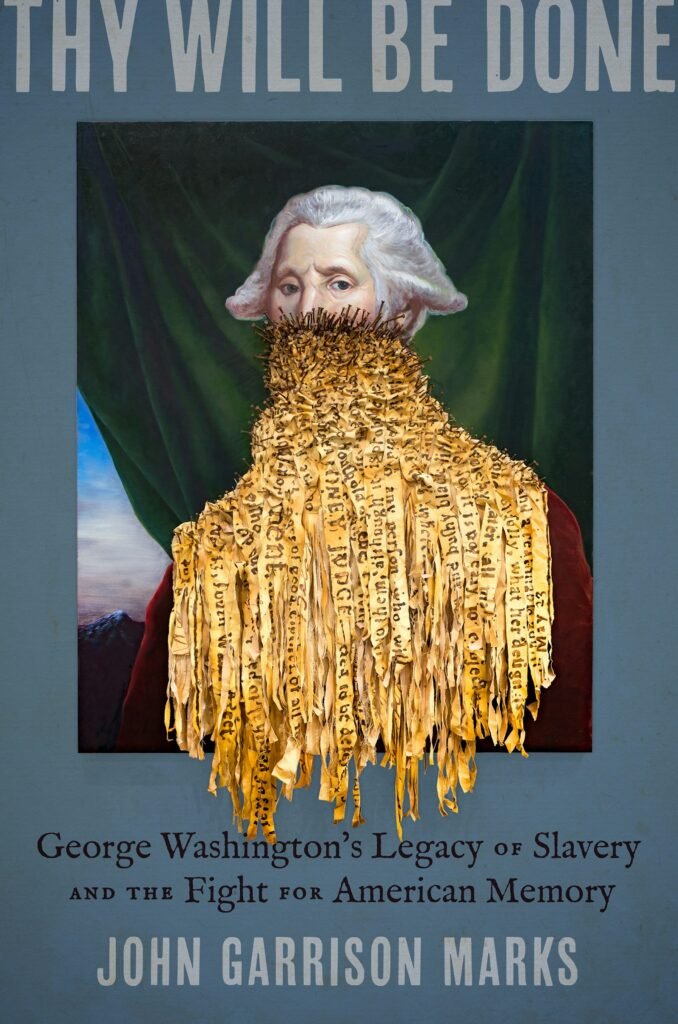
Americans don’t do ambiguity well is my main takeaway from John Garrison Mark’s, Thy Will Be Done: George Washington’s Legacy of Slavery and the Fight for American Memory. We like to remember our past in terms of heroes and villains, which is why we’ve fought over George Washington’s legacy of slavery since the nation’s founding. Depending on the needs of our ever shifting political circumstances, our founding father has been elevated to near infallible sainthood status or excoriated for actively partaking in the brutal practice of human bondage. Our desires, hopes, fears, and uncertainties are always changing but through it all George Washington’s legacy has always offered a usable past for us to assert what we believe it means to be American.
Spotlighting the folly of reducing Washington to a one-dimensional character, Marks begins with the facts about Washington’s relationship with slavery. Washington didn’t just rely on slave labor, he was one of the largest slaveholders of his day. In 1743, at age eleven, he inherited a 280 farm together with ten slaves. By the time of his death in 1799, the number of slaves at an estate which Washington expanded to 8,000 acres and renamed as Mt. Vernon, had grown to 316. Washington purchased some sixty men, women and children, and when he married, he added a far greater number of slaves from his wife Martha’s first husband’s estate. Throughout his entire adult life, including during his presidency, Washington was consumed with the details of how to best profit from his human resources. When his expectations weren’t met, he didn’t hesitate to sell and consign his slaves to near certain death on the brutal plantations in the Caribbean. When attempts were made to escape captivity, as with Ona Judge, he made every effort to track them down. It was Washington, in 1793, who signed into law the Fugitive Slave Act which gave slave owners the right to hunt down and return any slave seeking freedom through flight to the North. Fearful of the divisive nature of the subject for the young republic, never during his life did he try to speak out publicly or take a stand against the practice of slavery.
While there is no question that Washington was an active slave owner and beneficiary of slavery, it is equally true that privately he voiced serious doubts and misgivings about the practice. In letters to friends and associates he expressed his support for gradual abolition. He was convinced that steps being taken by a number of Northern states to introduce gradual abolition laws should be taken up by Congress. Marks notes that it is tempting to cast Washington as a man whose ideas about slavery evolved over time. But throughout his life Washington held contradictory views and opinions. While he was supportive of gradual abolition, for example, he circumvented these very same laws during his presidential stay in Philadelphia by carefully limiting the length of stay of his slaves, rotating them in and out of the city.
The most important public statement Washington made about slavery came after his death in his last will and testament. Framed not simply as the wishes of a resident of Fairfax Country Virginia, but as those of the former President of the United States, Washington used his last will and testament as a platform to appeal to the American people. What made this will so exceptional was Washington’s decision to emancipate all the slaves he owned following his wife’s death. No other founding father made any remotely similar gesture and few other private emancipations were on a similar size and scale. Washington’s decision was part of a trend in the late eighteenth century which he clearly wanted to support.
This century-long tug-of-war over slavery’s place in the nation’s history and in George Washington’s legacy reveals how—even as concerns about “new history” and civil rights shifted to political correctness to multiculturalism to critical race theory and then to the all-encompassing, ill-defined cudgel of “woke”—the foundations of these debates have barely shifted at all. John Garrison Marks, Thy Will Be Done: George Washington’s Legacy of Slavery and the Fight for American Memory.
Washington’s will went viral. Newspapers across the thirteen states reprinted parts or the entirety. Some publishers attempted to capitalize on Washington’s notoriety by publishing copies of the will complete with backstories about the president’s life. But despite its wide circulation and the clear public interest, Washington’s will become the first example of the silencing of his legacy of slavery. Printed editions of the will offered little or no commentary on Washington’s life as a slaveholder. No public debate took shape in response to Washington’s decision to emancipate his slaves or the practice of slavery. As part of a trend that would stretch from Washington’s death to the present, Washington’s legacy of slavery would be evoked only when the political context proved opportune. In the decades immediately following his death, the subject was deemed too potentially explosive for the young republic.
Silence about Washington as a slave owner and emancipator did not last long. As abolitionists and proponents of slavery squared off in the period leading up to the Civil War Washington’s legacy was evoked by all sides. Early abolitionists pointed to Washington’s decision to emancipate his slaves as evidence of his true character and thoughts about the practice. Nothing could be more American, the argument went, than emancipation. Later abolitionists took a more radical position and denounced Washington as a slaveholder, often in the most incendiary language. Marks cites abolitionist Parker Pillsbury as one of the harshest critics of Washington. Pointing to the hypocrisy of founding a nation based on the ideals of liberty and equality and the injustice of slavery, Pillsbury proclaimed that “the Revolution itself was a failure; the Declaration of Independence was a failure; Washington himself was a failure.”
Supporters of slavery found a variety of ways to claim Washington’s legacy for their own. As a lifelong slave owner Washington’s example clearly underscored the merits of the practice. While it is true that he made the decision to emancipate his slaves at his death it was only because he was childless and lacked an heir to which he could bequeath them. Proponents of slavery could point to Washington’s support for the Fugitive Slave Act of 1793, and his own relentless efforts to track down slaves who attempted to flee. In what would become a national pastime, supporters or opponents of slavery could cherry-pick from Washington’s past to lay claim to his legacy in support of views and objectives that were diametrically opposed.
The remembering and silencing of Washington’s legacy of slavery ebbed and flowed depending on the changing political tides. During the brief period of Reconstruction the memory of Washington as an emancipator gained public prominence in support of efforts to reform the unrepentant former slaveholding states of the Confederacy. As support for Reconstruction quickly waned, Washington’s memory as a benevolent slaverholder was evoked in support of the new Lost Cause mythology of the Jim Crow South. During a period of consensus about white supremacy, the memory of Washington as a slaveholder generally took a backseat to the practice of extolling his virtues for younger generations or immigrant arrivals to emulate.
Looking at how Washington’s Legacy of slavery has played out in American textbooks, Marks identifies the 1980s and 1990s as the high water mark for inclusiveness. Women, African and Native Americans gained increasing prominence in textbooks with the emergence of social history in the 1960s and the attention it paid to those who had been excluded from narratives about the national past. Moreover, the gains made during the civil rights movement and the increasing clout of African Americans created pressure to broaden the national narrative. Inspired by the spirit of the times and the change in scholarship, late 1960s textbooks, like Land of the Free, authored by the prominent African American historian John Hope Franklin, captured the important California textbook market.
Marks argues that the success of expanding the national story was both illusive and short-lived. Textbooks like Land of the Free, may have devoted more pages to women and minorities, subjects like slavery may have received more attention, but traditional American heroes such as George Washington remained unblemished by the crimes of the past. Moreover, in what Marks describes as a zero-sum perception of history textbooks, conservative began to regard any increase in the number of pages devoted to other peoples and subjects as a reduction in pages extolling the virtues and accomplishments of the founding fathers. In keeping with long standing concerns about the proper role of history, conservatives argued that textbooks should harness the past to bolster patriotic sentiments and allegiance to the nation. Overly nuanced treatments of the past, they believed, were simply too much for young minds to comprehend and could have potentially disastrous consequences for the nation.
Conservatives, Marks contends, waged a decades-long and ultimately successful struggle over the crafting of the national narrative in American textbooks. Particularly influential in this fight were the Texas couple Mel and Norma Gabler. The Gabler’s used their organization Educational Research Analysts, beginning in the 1980s, to review and assess textbooks for classroom use. George Washington, and the frequency of references to the nation’s founding father, became a litmus test for whether textbooks met the Glabers’ patriotic standards. Gaining leverage in the powerful Texas textbook market gave the Gablers an outsized influence over the entire national textbook market. By the early 2000s conservatives had won. Glowing references to George Washington appeared with ever growing frequency. Slavery could not be erased from the pages of the new textbooks. Instead, the focus centered on Washington’s emancipation of his slaves, a story which fit neatly into the narrative of the inexorable American march toward freedom, justice and liberty.
As we celebrate the 250th anniversary of the American Revolution, John Garrison Marks offers a mixed message about the present and future possibilities for remembering the American past. On the one hand conservatives have been successful in shaping how the national story gets told in American textbooks. Patriotism rather than critical treatments of the past are paramount in these highly influential resources. From legislation restricting critical approaches to history in the classroom to pressure on prominent national institutions like the Smithsonian to offer more uplifting stories, we are undoubtedly in the midst of a successful conservative backlash to the gains of the civil rights era. On the other hand, it is hard to put the genie back in the bottle. In his work with museums Marks finds that there is an ever growing sensitivity to the needs and interests of the public. Mount Vernon, to which Marks devotes a fascinating chapter, is one example of how the telling of the national past has become more inclusive and more open to critical perspectives. As American democracy has broadened so have demands for its story. Rather than threatening fragile young minds and undermining patriotism, more inclusive and complex treatments of the past, including that of George Washington, offer more relatable stories of resilience and courage that resonate with ever greater numbers of Americans.

John Garrison Marks
John Garrison Marks is Vice President of Research and Engagement at the American Association for State and Local History—the national professional association for public history institutions and professionals. He is the author of Black Freedom in the Age of Slavery: Race, Status, and Identity in the Urban Americas (2020) and Thy Will Be Done: George Washington's Legacy of Slavery and the Fight for American Memory (2026).